Newsletter Subscribe
Enter your email address below and subscribe to our newsletter
Enter your email address below and subscribe to our newsletter

 ByJohn A
The smell comes back. The smell comes back the morning after every shower, which is one reason a bathroom remodeling Hendersonville NC conversation so often starts in a windowless hall bathroom nobody wanted to touch. Then the floor beside the tub gives a little underfoot. Here is the argument in one sentence: a musty odor that returns daily alongside a soft floor means water has already moved past the surface, and no bead of sealant reaches what sits behind it.
Musty is a biological smell, not a plumbing smell. It comes from growth feeding on something damp and organic: the paper face of drywall behind a fiberglass tub surround, the felt under an old tile floor, the raw particleboard edge of a vanity. Put that in a 34 square foot hall bathroom with no window, in a 1980s Hendersonville split level whose exhaust fan dumps into the attic instead of through the roof, and every shower loads moisture into framing that never fully dries between uses. An air freshener treats the room. The room was never the problem.
The EPA’s guidance on controlling indoor mold frames all of this as a moisture problem rather than a cleaning problem: vent bathrooms to the outdoors, hold indoor humidity between 30 and 60 percent, and dry wet building materials within 24 to 48 hours, since growth takes hold past that window. A fan discharging into an attic fails the first instruction before the other two get a chance to matter. The safety piece belongs in plain language too: anyone with asthma, allergies, or a weakened immune system should stay out of the room while wet material is being opened up, and a large area of growth calls for professional containment and cleanup rather than a spray bottle and a rag.
See also: Four Beliefs That Stall An HOA Entry Monument Project
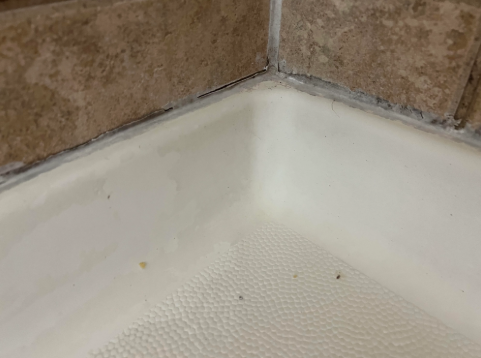
Stand beside the tub apron and shift your weight onto that one spot. Flex there is a structural report, delivered free. What we find most often is a slow wick rather than a burst pipe: a failed joint at the tub and tile lets a thin film past the surround, the water runs down inside what remodelers call the wet wall, meaning the stud bay carrying the shower valve and drain lines, and the subfloor takes it on from the one edge nobody can see. Tile hides that progress for years because tile stays rigid and cheerful about it. The floor tells on the wall first.
There is no honest way to tell a homeowner how long the leak has been running. Nobody tracks the start date of a slow one, moisture meters read what is wet today rather than what was wet three winters ago, and stain patterns mislead in both directions. I have opened a wall braced for two years of rot and found one joist bay dark and soft with its neighbor dry as a bookshelf, and I still cannot explain that gap cleanly. What the flex does settle is the category of the repair. It is carpentry now, not cosmetics.
Recaulking is not wrong. It is just small, and a joint redone three times in two years is data rather than bad luck. Sealant closes a gap, but it never dries out a wall. A This Old House remodeling cost guide updated in August 2026 puts the shower or tub, the vanity, and the tile at the top of the bathroom budget precisely because those are wet areas built to resist water, which is also why they are the parts that fail hardest when the water resistance was never really there.
Say a fresh bead of sealant and an afternoon of regrouting costs $80 in materials and half a Saturday, and say it holds for eight or nine months in a bathroom two people use daily. Do that three times and you have spent three afternoons keeping a seam looking closed while the substrate behind it stayed wet the entire time. In practice the real cost is not the caulk. It is the extra months of soaking that each round quietly buys, on framing that has no way to shed the water and no air moving across it.
Demolition sounds like the expensive answer and it is usually the cheap one, because it converts guesses into a list. Pull the surround, cut back the damaged sheathing and subfloor, and the question resolves in about an hour: how far the water traveled, which joist bay took it, whether that vent duct ever reached the roof at all. Repairs then get sized to what is actually there instead of what a smell suggests. Waterproofing goes in the way it should have the first time, the fan gets ducted outside, and new tile lands on a substrate that will not need rescuing in eighteen months.
That is the practical case for treating bathroom remodeling Hendersonville NC homeowners keep postponing as a repair project rather than a decorating one. A crew opening the wet wall during a remodel does the diagnosis and the fix in the same week, with the floor already up and the framing in plain view. If your hall bathroom smells a day after every shower and the floor moves under your heel, the next purchase is not another tube of sealant. It is a demolition day and an honest look at everything the water reached.