Newsletter Subscribe
Enter your email address below and subscribe to our newsletter
Enter your email address below and subscribe to our newsletter

 ByJohn A
The garage floor in Lacey sits near 45 degrees on a February morning, and the 40-gallon gas tank standing on it has started leaving a rust ring on the concrete. Both companies that came out were called for the same thing, water heater installation Lacey WA homeowners tend to think about only after the first cold shower, and both left a quote. One replaces the gas tank with another gas tank for about $4,100. The other proposes a heat pump model, a new 240-volt circuit and a condensate line, for about $5,400. Nothing on the two sheets lines up, so there is no honest way to call either one cheaper. Two bids cannot be compared until both price the same installed conditions, and forcing those conditions onto the page is the homeowner’s job.
A like-for-like gas swap reuses the flue that is already there, the existing gas line and the drain path the old tank used. A heat pump unit changes all of those assumptions at once: no combustion venting, a dedicated 240-volt circuit, a condensate line that has to reach a drain, and enough open air around the tank for the compressor to do its work. Removing or re-routing a gas water heater’s vent is licensed, permitted work in Washington, and it is not the line item to shave. The U.S. Consumer Product Safety Commission ties more than 100 deaths a year to carbon monoxide from consumer products, and it recommends a CO alarm near the bedrooms in each sleeping area along with an annual professional inspection of the heating system.
If a carbon monoxide alarm sounds, get everyone out of the building and call 911 from outside. Do not open windows first and hope.
See also: How Regular Drain Maintenance Improves Home Hygiene
A heat pump water heater does not make heat. It moves heat, pulling warmth out of the air around the tank and pushing it into the water, which is why the air it exhausts leaves cooler and drier than the air it took in. Manufacturers rate those units at a mild indoor temperature, usually somewhere around 67 degrees, and a rating measured at 67 degrees will not do you any favors in a 45 degree garage. Performance does not vanish at that point. It slides, and once the space drops below the unit’s minimum ambient temperature the machine stops leaning on the compressor and falls back on its electric resistance elements, which is the expensive way to heat water.
Two numbers on the spec sheet settle most of this argument: the lowest ambient temperature the compressor will run at, and the air volume the unit needs, which often lands somewhere near 700 to 1,000 cubic feet unless the installer ducts it. A Lacey garage with the door sealed and no heat source can sit under that minimum for days during a cold snap. The mismatch I run into most often is a unit sized correctly for the household’s hot water and then installed in a space that starves it of air. Condensate is the other quiet detail, because a heat pump unit sheds water the way an air conditioner does, and that water needs a drain or a small pump rather than a bucket somebody remembers to empty.
A couple on the north side of town put one in an uninsulated detached garage, then spent a winter listening to the resistance elements run every evening. They added foam board on the shared wall and a duct kit the following spring, and the bills came back down. That repair cost roughly $600 nobody had planned for, which is money that belonged in the original bid.
The savings case for a heat pump unit is real, and it is narrower than the brochures suggest. Plumbing & Mechanical, in a July 2026 piece asking whether the trade is ready for these heaters, put the figure at roughly $400 a year and about a 70% reduction in the cost of operation. Read that baseline closely, because the comparison is against a conventional electric tank, not against the gas unit currently rusting in the garage. Gas is the incumbent here, so the real question is what gas and electricity will each cost across the ten or twelve years the new tank has to survive.
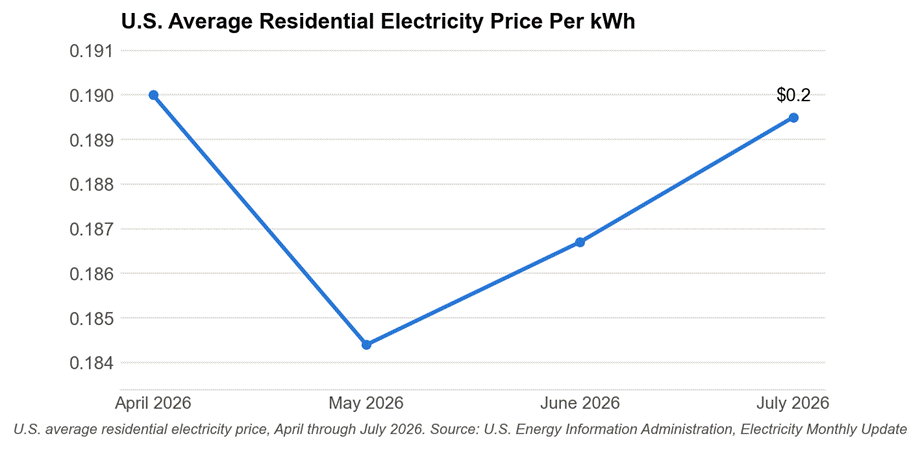
Electricity is not a fixed input in that math. The national residential average moved through the spring and summer rather than holding still, which is worth checking before anyone commits to a payback year. Any payback estimate built on one flat rate for a decade is a guess.
Day one is usually a site visit rather than a truck full of equipment, because the permit, the circuit and the venting decision all get settled before anything is ordered. The swap itself takes most of a day for a straight gas replacement and longer for a heat pump conversion, since an electrician is often on site for the 240-volt run. Expect the first week to include an inspection appointment tied to the permit. By month three you will know whether the condensate line drains the way it should, which is when small shortcuts start showing themselves. Within 90 days the warranty should be registered too, because most manufacturers want proof of a licensed install and the homeowner who cannot produce it finds out at the worst possible moment.
Ask both contractors to price the same four items in writing: the venting or its removal, the electrical work, the condensate route, and the permit with its inspection. Once those appear on both sheets, the $4,100 and the $5,400 stop being a mystery and turn into a choice about equipment. A Plus Services quotes water heater installation Lacey WA properties on those conditions across Thurston County, which is what makes two bids answerable side by side. Whichever unit wins, let the installed conditions decide it rather than the number printed at the bottom of the page.