Newsletter Subscribe
Enter your email address below and subscribe to our newsletter
Enter your email address below and subscribe to our newsletter

 ByJohn A
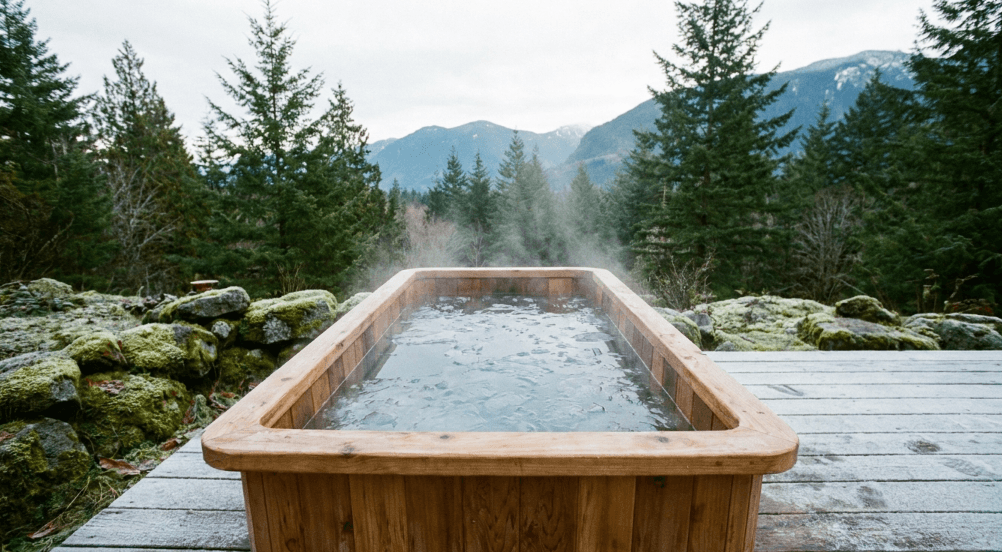
An outdoor cold plunge can run through a genuinely cold winter without freezing or damage, but it needs a few specific safeguards: continuous circulation, an insulated or heat-traced line for the chiller loop, a floating cover, and a plan for what happens to the equipment if the power goes out. Skip any one of these and a hard freeze can crack a pump housing or split a line in a single overnight cold snap.
Standing water freezes faster than moving water, so the first rule for winter operation is to keep the circulation pump running continuously rather than cycling it on and off. Most residential chiller units are rated to operate in ambient temperatures well below freezing as long as the water itself stays above roughly 39 degrees Fahrenheit, which the chiller’s own compressor maintains. The risk is almost always in the exposed plumbing, not the tub itself, since a few feet of unprotected line between the tub and the equipment pad is where ice tends to form first.
Beyond the equipment, snow and ice accumulation around the tub’s base is worth checking after every storm, especially for a tub sitting on a gravel or paver pad rather than a covered deck. Compacted snow around the shell can trap moisture against the material and, in freeze-thaw cycles, contribute to cracking over several seasons. A quick clearing of the immediate area after a heavy snowfall, plus keeping the drain and overflow points free of ice, is a small habit that meaningfully extends the equipment’s working life through a hard winter.
Any tubing that runs outside the insulated shell of the tub, especially the return line to a chiller or filter, benefits from foam pipe insulation at minimum, and a heat-trace cable underneath that insulation in genuinely harsh climates. This is a small, inexpensive add-on compared with the cost of a burst line or a replacement pump housing after a freeze. Anyone in a climate that regularly drops below 10 degrees Fahrenheit overnight should treat heat tracing as close to mandatory rather than optional.
A tight-fitting floating cover cuts heat loss dramatically between plunges and keeps snow, leaves, and ice chunks out of the water. It also slows evaporative cooling, which is a bigger factor outdoors in dry winter air than most people expect. A cover paired with a running chiller means the system works less overall, since it is not fighting constant heat loss to open air every time the tub sits unused for a few hours.
A prolonged outage in freezing weather is the real threat to equipment, not the cold plunge itself. Some owners keep a small battery backup or generator on hand specifically to keep the circulation pump running during a power interruption, since a still tub can begin forming surface ice within a few hours in single-digit weather. If a real freeze risk is forecast and backup power is not available, draining the equipment lines, though not necessarily the tub, is the safer move.
Winter plunging adds a few practical steps that summer sessions do not need. Keep the walking surface between the tub and your warm-up space clear of ice, since a wet body on a frozen path is a real slip risk, and a rubber-backed mat or salted stepping area near the tub goes a long way. Have a heavy robe, dry towel, and warm footwear staged within arm’s reach rather than in a house or garage several steps away, since the minute right after exiting cold water is when body temperature drops fastest. Many winter plungers also keep sessions shorter than they would in summer, a minute or two rather than pushing for a longer hold, since the combination of cold water and cold air adds up faster than either alone.
Not every chiller and cover combination is rated for genuine four-season outdoor use, so it is worth checking the manufacturer’s minimum operating temperature before buying rather than after the first hard freeze. A retailer that carries winter-rated tubs and chillers side by side makes this comparison easier; you can check what is in stock for units built to handle sustained sub-freezing air temperatures before committing to a specific model.
The physiological response to cold-water immersion does not change meaningfully with outdoor air temperature, since the water itself, not the surrounding air, drives the effect. A 2025 PLoS One meta-analysis on cold-water immersion reported consistent short-term associations with mood improvement and reduced inflammatory markers across the pooled studies, regardless of season or setting. A Cochrane review of post-exercise cryotherapy likewise found modest soreness-reduction effects tied to water temperature and immersion time rather than ambient conditions, which is a reminder that winter plunging is not inherently more or less effective, just harder on the equipment.
A running chiller keeps water well above freezing year-round, but a tub left idle without power or insulation can freeze in sustained sub-20-degree weather. A floating cover and a small circulation pump both help prevent ice from forming.
Yes, in most cases. Ambient cold air cools the water slowly and unevenly, while a chiller holds a precise, repeatable temperature regardless of the weather, which matters for anyone tracking sessions consistently.
Most manufacturers recommend heat-traced or insulated tubing for exposed lines, along with keeping the system running continuously rather than shutting it off overnight, since standing water in a line freezes faster than moving water.
Many people do it safely by limiting exposure time and having a warm, dry space to move into immediately afterward, since the risk in cold weather comes more from the transition out of the water than the plunge itself.
Only if you plan to stop using it entirely. Draining and winterizing the lines is the right move for a seasonal setup, but any tub you intend to keep using should stay filled and running to avoid freeze damage to the chiller and plumbing.