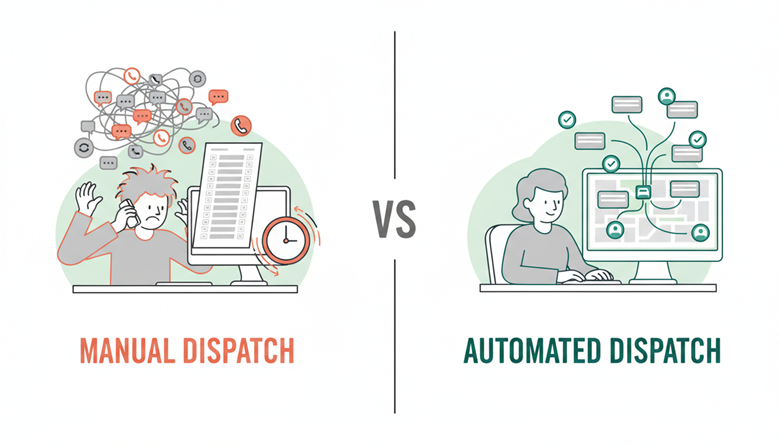
You have 35 orders on screen and four drivers on the road. You are texting each one, waiting for replies, guessing who is closest. By the time you assign the last order, three customers have already called asking where their food is.
This post covers what separates real delivery dispatch automation from the spreadsheets and group chats you are duct-taping together right now.
What Most Tools Get Wrong
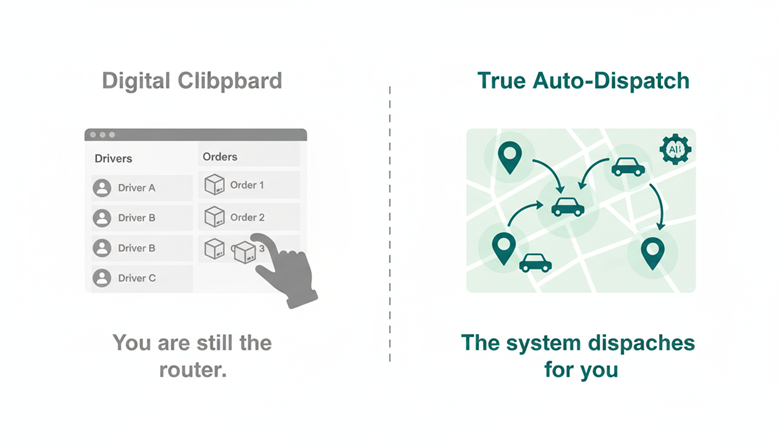
Generic dispatch tools treat your operation like a taxi service. They give you a list of drivers and a list of orders, then leave you to play matchmaker.
That is not automation. That is a digital clipboard.
Most delivery dispatch apps show you a dashboard but still expect you to decide which driver gets which stop. They ignore proximity, ignore who just finished a run, and ignore the fact that you have a restaurant to manage — not just a logistics desk.
If you are still the bottleneck between an order and a driver, your tool is not dispatching. You are.
What a Good Delivery Dispatch Tool Actually Does
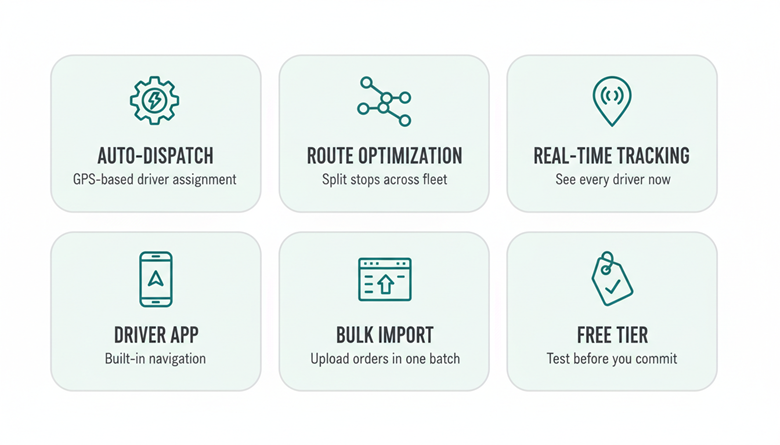
Auto-Dispatch Based on Location and Availability
The tool should assign orders to drivers without you touching a button. It reads each driver’s GPS position, checks who is available, and sends the job to the best match. Without this, you are paying for software that still requires your brain as the router.
Route Optimization Across Multiple Drivers
A single driver with six stops needs an optimized sequence. But the real win is when the tool splits stops across your whole fleet. A strong route planner distributes work so no driver is overloaded while another sits idle.
Real-Time Driver Tracking on a Live Map
You need to see every driver on a map, right now. Not five minutes ago. When a customer calls, you should answer in seconds, not put them on hold while you text the driver.
A Driver Mobile App with Built-In Navigation
Your drivers should not toggle between a dispatch app and a maps app. The tool should hand them turn-by-turn directions inside the same screen where they accept the order. Fewer app switches means fewer missed turns and faster deliveries.
Bulk Order Import
If you process orders from catering sheets, CSV exports, or Excel files, you need a tool that lets you upload them in one batch. Typing 40 addresses by hand defeats the purpose of automation.
See also: Fashion Product Developer and Tech Designers
A Free Tier You Can Test Without a Sales Call
You should be able to load real orders and real drivers before you commit a dollar. Any tool that hides behind a demo request is betting you will not compare it to the competition.
Habits That Make Dispatch Automation Work
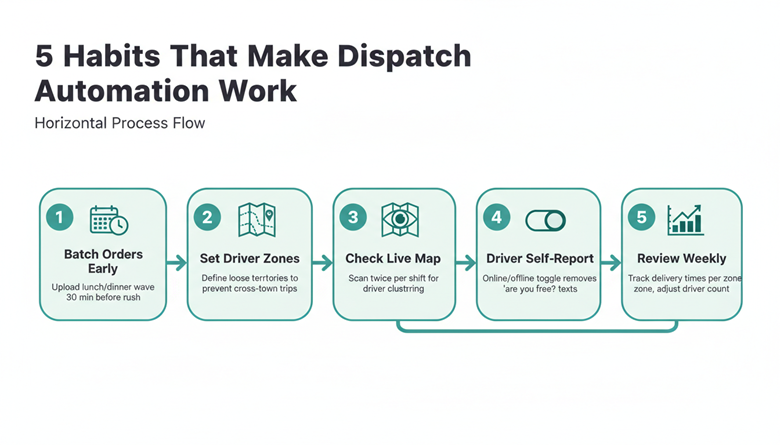
Batch your orders before the rush. Upload your lunch or dinner wave 30 minutes early. Let the system pre-assign routes so drivers roll out the moment orders are ready.
Set driver zones. Even with auto-dispatch, defining loose territories prevents a driver from crossing town when someone closer is free. Most tools let you draw zones on a map.
Check the live map twice per shift. Not to micromanage — to catch clustering. If three drivers are stuck in one neighborhood, you can manually reassign the outlier. A good route planner shows this at a glance.
Let drivers self-report availability. A driver app with a simple online/offline toggle removes you from the “are you free?” text chain entirely.
Review delivery times weekly. Automated dispatch only improves if you look at the data. Track average delivery time per zone and adjust driver count accordingly.
Your Competitors Already Stopped Dispatching by Hand
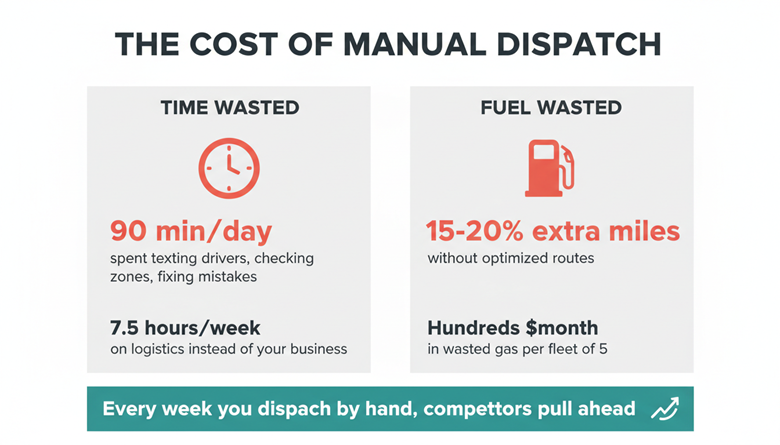
A restaurant running 40 deliveries a day spends roughly **90 minutes** on manual dispatch — texting drivers, checking zones, fixing mistakes. That is 7.5 hours a week spent on logistics instead of food, service, or growth.
Fuel costs compound the problem. Without optimized routes, drivers cover 15-20% more miles than necessary. On a fleet of five drivers, that is hundreds of dollars in wasted gas every month.
The operations down the street that switched to automated delivery dispatch are not working harder. They loaded their orders, let the system assign drivers, and went back to running their business.
Every week you dispatch by hand is a week your competitors pull further ahead.