Newsletter Subscribe
Enter your email address below and subscribe to our newsletter
Enter your email address below and subscribe to our newsletter

 ByJohn A
Mould outbreaks threaten student health, reputation, and risk criminal prosecution under the WHS Act. This guide breaks down hidden indicators, essential air quality benchmarks, and the 5-stage professional remediation protocol to protect your school and secure a clearance certificate.
Key Takeaways
You might have heard about the New South Wales school where mould had infested furniture, plasterboard, carpets, and even drum kits. That Broken Hill’s Willyama High School was ordered to be demolished and rebuilt by the state education minister. Do not risk your school’s and everyone’s well-being like Willyama High School.
Because when it’s moulds, the students’ health, your reputation, and legal liability are all at stake! If you are worried about your school’s mould problems, by the end of this blog, you will know exactly what to do.
High occupancy leads to elevated humidity and aging demountable classrooms, post-flood/storm cycles, alongside inadequate HVAC maintenance, resulting in mould formation. Considering Australia’s weather, which covers the tropical north, the humid east coast, and the temperate south-west, moulds are bound to happen. Moreover, children breathe faster and have developing immune systems, making them more susceptible than adults.
Schools are PCBUs (persons conducting a business or undertaking) under the WHS Act 2011 and hold a primary duty of care under Section 19. This duty extends to students, staff, contractors, and visitors. And unlike generic workplaces, you will need to follow a higher standard of care for schools, as it involves young students. So, if you do not conduct mould testing, the school operators can face potential criminal prosecution if the law is breached.
See also: Strategic AI Adoption: Transforming Global Business Services Operations
This table will tell you which mould species are common in Australian schools and where you will find them. Know why these are risky and harmful to health.
| Mould species | Common in schools on… | Health impact | Risk to students |
| Cladosporium | Carpet, fabric, window frames, HVAC ducts | Allergic reactions, respiratory irritation, and skin rashes | Moderate — common allergen |
| Penicillium | Wallpaper, insulation, water-damaged plasterboard | Respiratory problems, sinus infections; some strains produce mycotoxins | Moderate–high |
| Aspergillus | HVAC systems, damp walls, building cavities | Asthma exacerbation, lung infections, and immunocompromised students at risk of aspergillosis | High — medically significant |
| Alternaria | Showers, toilets, damp tiles, outdoor-facing walls | Allergic rhinitis, asthma | Moderate |
| Stachybotrys chartarum (black mould) | Prolonged water-damaged plasterboard, timber, and cardboard | Severe respiratory symptoms, headaches, fatigue; mycotoxin (satratoxin) production | Very high — requires professional remediation |
Table 1: Common Health Species in Australian School Buildings
There are two types of signs to consider:
Visible Indicators: Common signs include discoloration of any spot and the formation of fuzzy patches.
Invisible Indicators: Common signs include persistent musty odor, unexplained respiratory complaints from students/staff, and condensation on windows.
This shows that visual mould assessment in Sydney or anywhere alone is inadequate. You need to consider the 1000 spores/m³ air quality benchmark as per the Australian Mould Guideline 2010. Also note that an indoor/outdoor (I/O) ratio exceeding 2:1 signals active indoor amplification is also essential.
The school administrator’s action protocol should involve the following, beginning with training all the school staff about the same.
Here’s what your school should expect if the building is already affected by mould and needs clearing.
| Stage | Who conducts it | What happens | Outcome |
| 1. Initial assessment | Independent occupational hygienist | Visual inspection, moisture mapping, air and surface sampling, and identification of contamination source | Assessment report with remediation recommendations |
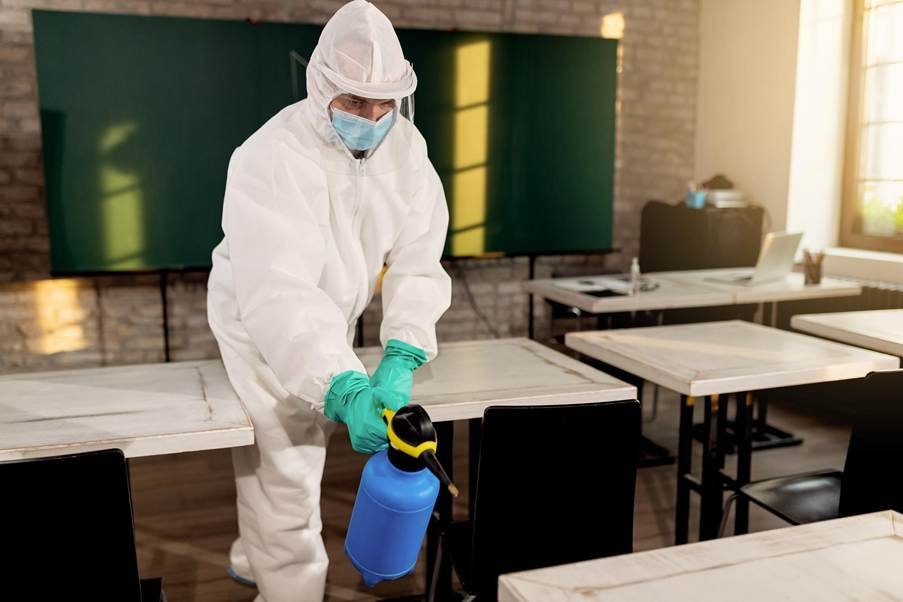
| 2. Containment | Licensed remediation contractor | Affected zones isolated; negative air pressure established; PPE deployed; HVAC isolated to prevent spore spread | Unaffected areas protected |
| 3. Remediation | Licensed remediation contractor | Mould-affected materials removed or treated per AS-IICRC S520:2025; HEPA vacuuming; antimicrobial treatment; structural drying | Contaminated material removed; surfaces treated |
| 4. Source correction | Building/maintenance contractor | Moisture source fixed — roof leaks, plumbing, condensation pathways, HVAC service | Recurrence risk reduced |
| 5. Post-remediation verification | Independent occupational hygienist | Air and surface sampling repeated; I/O ratio verified below 2:1; spore count below 1000 CFU/m³ | Clearance certificate issued |
Table 2: How Mould is Remediated
To make sure that the mould does not return to your school building, here’s what you need to do.
Note that the prevention cost is a fraction of the remediation cost.
If you’ve identified mould in your school, the first step is always an independent professional assessment. Hire professional services of mould assessment in Sydney immediately! Don’t delay, as mould spreads rapidly in warm, humid conditions. Remediate it before it spreads out of control.